
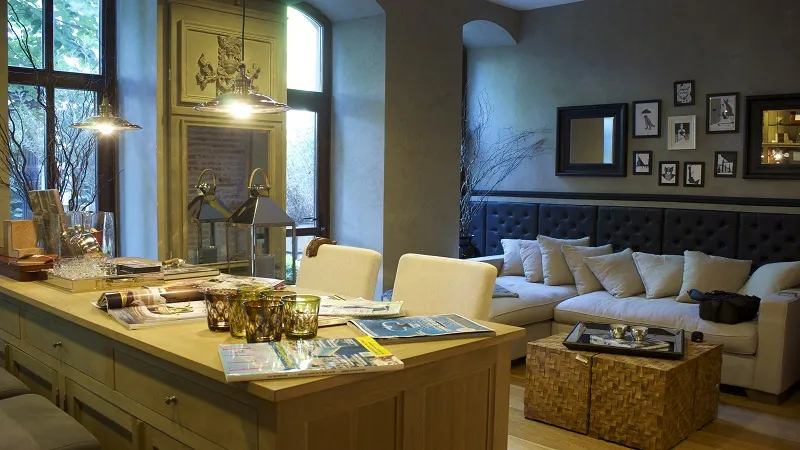
If you live in the UK, chances are at least one of your rooms is smaller than you’d like. Box bedrooms, narrow hallways, and snug living rooms come with the territory. Interior designers deal with this constantly, and they’ve built up a reliable set of tricks to make tight spaces feel open. Read on, and you’ll have a few you can try this weekend.
Visual Weight and Why It Matters
Designers talk a lot about “visual weight”. It’s the idea that some objects feel heavier to the eye than others, even when they’re the same physical size. A solid oak sideboard reads as bulky and grounded. A slim metal frame chair barely registers.
The trick with a small room is to cut down on visual weight wherever you can. Bulky, dark, opaque pieces eat into a space and make the walls feel closer. Lighter, see-through, and reflective items do the opposite. They let your eye travel further, which fools the brain into thinking there’s more room than there really is.
Clear Acrylic Furniture That Disappears
One of the best ways to drop visual weight is to use clear acrylic furniture. A transparent coffee table, side table, or console takes up its physical spot in the room, but your eye passes straight through it. You still get a usable surface without the visual bulk.
Acrylic is also up to ten times more impact resistant than glass and won’t break into sharp shards if it’s knocked, which makes it a safer pick around children, pets and busy floors. It transmits more light too, up to around 92% compared with 80 to 90% for standard glass, so the whole piece reads as brighter and lighter in the room.
Floating acrylic shelves work for the same reason, holding books and ornaments while the wall behind stays visible. If you fancy building your own pieces, suppliers like Simply Plastics will cut sheet to size with polished edges and pre-drilled holes, which makes a tidy DIY shelf or desk a realistic weekend project.
Mirrors and Reflective Surfaces
Mirrors are the oldest trick in the book, and they still work. A large mirror placed opposite a window bounces daylight back into the room and doubles the sense of depth. Lean a tall one against the wall in a narrow hallway and the space instantly feels wider.
You don’t have to stop at obvious mirrors either. Acrylic mirror panels, glossy cabinet doors and metallic accents all push light around. The aim is to keep surfaces working for you instead of soaking up the light and shrinking the room.
Light Colours and Continuous Flooring
Pale walls reflect more light than dark ones, so a small room painted in soft whites, warm greys or muted pastels will feel airier straight away. Painting the skirting and trim the same shade as the walls removes hard lines that chop a room into sections.
Flooring matters too. Running the same floor through from one room to the next tricks the eye into reading them as a single, larger space. A few things help here:
- Lay floorboards parallel to the longest wall to stretch the room
- Keep rugs large enough that furniture legs sit on top, not floating around the edge
- Avoid busy patterns that draw the eye to the boundaries
Layered Texture Without the Bulk
UK interiors in 2026 are leaning hard into layered textures, with warm neutrals, natural fibres and tactile finishes like limewash and raw timber doing most of the heavy lifting. That works beautifully alongside clear and reflective pieces in a small room. You can add warmth with a chunky knit throw, a woven basket or a linen cushion, then keep the bigger items light and see-through so the room never feels heavy.
The balance is what counts. Texture stops a pale, minimal room from looking cold and clinical, while the clear and reflective elements keep everything feeling open. Get that mix right and even a box room reads as calm instead of cramped.
In a Nutshell
None of these tricks need a builder or a big budget. Swapping a bulky table for a clear one, hanging a mirror across from the window, and sticking to a pale, continuous colour scheme will shift how a room feels almost immediately. Start with one or two changes, see how the space responds, and build from there. You’ll be surprised how much bigger a small room can feel once you stop fighting it. See more.